I Started Thrifting for the Deals. I Stayed for Something I Didn't Expect.
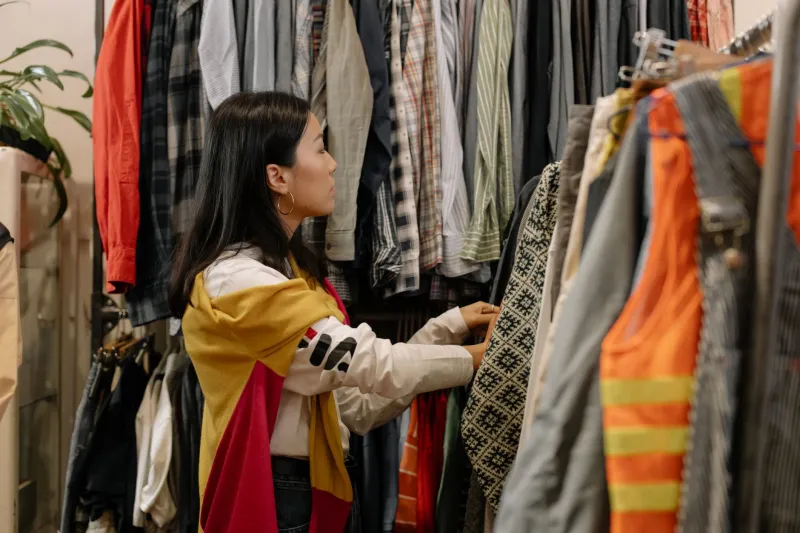
The first time Priya walked into a Goodwill, she was looking for a Halloween costume. She was 28, broke-ish, and had exactly zero romantic feelings about secondhand shopping. It was practical. It was temporary.
That was four years ago. Now she describes thrifting as "the thing that completely changed how I think about buying anything, new or used."
Her story isn't unique. Across the country, people who started thrifting for financial reasons — or out of environmental guilt, or because it was trending on TikTok — have ended up somewhere unexpected: with a fundamentally different relationship to consumption itself. Not because thrifting made them minimalists or anti-capitalists or any particular label. But because the process of thrifting quietly taught them things that translated into every other area of their shopping life.
The Slowness Is the Point
Here's the thing about thrifting that nobody really tells you upfront: you can't rush it. You can't filter by size and color. You can't sort by price. You just have to look.
For people conditioned by the modern e-commerce experience — where you can go from impulse to doorstep in 48 hours — that slowness is initially maddening. Then something shifts.
"I started noticing things I'd completely trained myself not to notice," says Devon, a UX designer in Portland. "Like, the weight of a fabric. Whether a piece felt sturdy or flimsy. Whether I actually liked something or just thought I was supposed to like it. When you can't just buy the first thing you see, you start developing opinions."
This is one of the most consistent themes across people who thrift regularly: the practice of looking without immediately buying builds a kind of shopping literacy that most of us never develop in the era of one-click purchasing. You learn what you actually prefer. You learn the difference between wanting something and wanting to want it.
The Death of Comparison Culture (Sort Of)
Social media has done something insidious to the way we shop: it's made our purchases feel like statements in a conversation we're always in the middle of. The right bag, the right brand, the right aesthetic — there's an invisible audience we're performing for, even when we're alone in our own homes.
Thrift stores don't play that game. There's no algorithm serving you the thing your favorite influencer just bought. There's no "customers also purchased" nudging you toward a coordinated look. There's just a rack of stuff, and whether you like it.
"I stopped caring about brands almost entirely," says Marcus, a teacher in Atlanta who started thrifting during the pandemic. "Not in a performative way — I didn't make some big declaration about it. I just stopped noticing. Because at the thrift store, the label means nothing. Either the piece is good or it isn't."
This quiet decoupling from brand-as-identity is something a lot of regular thrifters describe. And once it happens in the thrift store, it starts bleeding into how they shop everywhere else. They start asking do I actually like this? instead of is this the right thing to like?
Patience as a Shopping Skill
Priya — the one who started with a Halloween costume — talks about what she calls "the thrift store no." It's the moment when you find something that's almost right and you put it back anyway.
"In regular stores, I used to talk myself into things constantly. 'It's close enough. I could make this work.' At the thrift store, I learned to just say no and keep looking. Because there was always something else on the rack. And eventually, you find the thing that's actually right — and you know the difference because you've said no to a hundred things that weren't."
This patience, once developed, doesn't stay contained to secondhand shopping. It becomes a general posture toward purchasing. A willingness to wait. A comfort with leaving empty-handed. A confidence that the right thing is worth holding out for, whether it's a $4 thrifted lamp or a $200 new one.
For people who struggle with impulse buying — and that's most of us, to varying degrees — the thrift store is an unlikely training ground for restraint.
Presence as a Byproduct
There's something almost meditative about a good thrift session, once you stop fighting the format. You're not multitasking. You're not scrolling. You're just moving through a space, looking at things, touching things, thinking about whether they belong in your life.
"It sounds weird, but thrifting is one of the few times I'm fully present," says Nadia, a nurse in Phoenix. "My phone stays in my pocket. I'm not thinking about work. I'm just in the zone of looking. That's actually kind of rare for me."
This is backed up by what we know about flow states — the psychological condition of being fully absorbed in an activity. Thrifting, with its unpredictability and its requirement for sustained attention, creates conditions that are genuinely conducive to presence. In a world where most shopping happens in the fractured, distracted space of a phone screen, that's not a small thing.
The Mindset That Travels
Here's the part that surprises most people who discover it: the thrifting mindset — slow, discerning, patient, presence-based — doesn't have to stay in the thrift store.
The same questions you learn to ask while flipping through a rack of secondhand denim apply to any purchase. Do I actually love this? Will I still want this in a year? Does this fit the life I have, or the life I imagine? These are good questions. They're just easier to practice somewhere that doesn't have a marketing budget trying to manipulate your answers.
At Ambiya, we think about curation in a similar way. Not every product is for every person. The goal isn't to sell you the most things — it's to help you find the right things. The ones that earn their place in your home. The ones you'll still be glad you bought two years from now.
Thrifting, it turns out, is a pretty good teacher of that same principle. Even if you never set foot in a Goodwill.
One More Thing
Priya found her Halloween costume that first trip. She also found a ceramic planter, a cookbook she still uses weekly, and a linen blazer she's worn more than anything she's bought new since.
But more than any of those things, she found a different way of moving through stores — any store. Slower. More honest with herself. Less susceptible to the urgency that modern retail is specifically engineered to create.
"I'm a better shopper now," she says. "Not because I know more about brands or trends. Because I know more about what I actually want."
That's the real find.