When the Past Moves In: Rethinking the Childhood Stuff You Can't Seem to Let Go
There's a very specific kind of guilt that kicks in when you're staring at a box of old trophies, a stack of worn paperbacks from middle school, or a ceramic figurine your grandmother gave you when you were nine. You don't love these things exactly. But you don't not love them either. So they stay. They migrate from apartment to apartment, from storage unit to spare bedroom closet, quietly accumulating square footage in your life without ever really earning it.
This is what we're calling the past-creep problem — and it's more common than you'd think.
The emotional tangle around childhood objects is real, and it's worth taking seriously. But there's a difference between honoring your history and letting it crowd out your present. Learning to tell those two things apart? That's where a more intentional home actually begins.
Why Nostalgia Has Such a Strong Hold on Us
Human beings are wired to attach meaning to objects. It's not a flaw — it's deeply psychological. Research in the field of material culture suggests that physical items serve as anchors to identity, especially during formative years. That old baseball glove isn't just leather and laces. It's a whole chapter of who you were: the smell of cut grass, your dad in the bleachers, the version of yourself that believed anything was possible on a Saturday afternoon.
Nostalgia, in moderate doses, is actually good for us. Studies have linked nostalgic reflection to increased feelings of social connectedness and self-continuity. The problem isn't that you feel something when you look at these objects. The problem is when the feeling becomes the reason you keep everything, regardless of whether it still serves your life.
There's also guilt in the mix — which is sneaky and worth naming. A lot of the stuff cluttering adult homes isn't there because it brings joy. It's there because getting rid of it feels like a betrayal. Of a parent. Of a younger self. Of a memory. That's not nostalgia. That's obligation wearing nostalgia's clothes.
The Difference Between Meaningful and Just Old
Here's a question worth sitting with: Would you buy this item today if you saw it in a store?
Not the memory. Not the story. Just the object itself. Would it earn a place in your home on its own merits?
For some things, the answer is a clear yes — and that clarity is actually freeing. A quilt your aunt hand-stitched, a record that still gets played, a piece of art that genuinely speaks to your taste now. These items have crossed the threshold from sentimental to living. They belong.
But a lot of childhood stuff doesn't pass that test. The plastic trophies from a sport you quit in seventh grade. The stuffed animals you kept because throwing them away felt mean (to the stuffed animal, somehow). The collection of keychains from family vacations that you never look at and couldn't identify without reading the labels.
These objects aren't doing anything for you. They're just... present. And their presence has a cost — in physical space, yes, but also in mental bandwidth. Every item in your home asks something of your attention, even subconsciously.
A Simple Framework for Sorting Through It
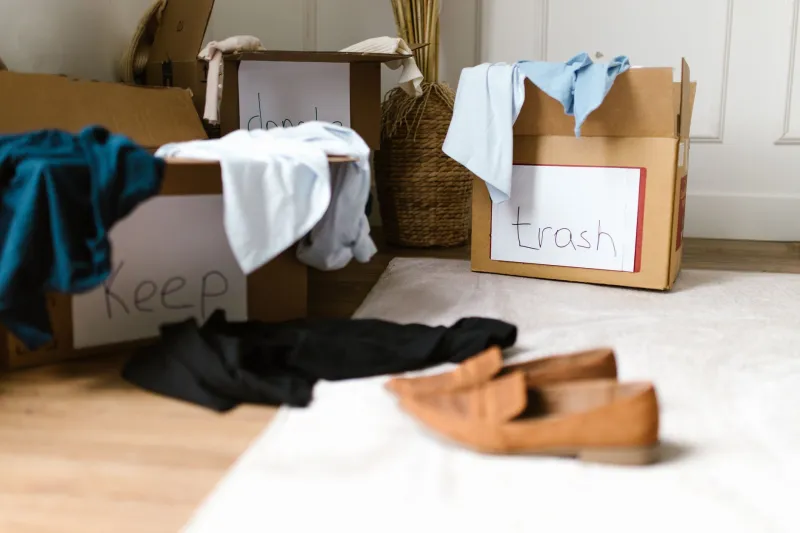
When you're ready to actually tackle the stuff from your past, it helps to approach it with a structure rather than just vibes. Here's a loose framework that works for a lot of people:
1. The Active Joy Test Do you interact with this item? Does it make you smile when you see it, or do you mostly not notice it anymore? There's a difference between something that genuinely lights you up and something you've just stopped seeing.
2. The Story You'd Tell Could you tell someone a specific, real story about why this object matters to you? Not a vague "it's sentimental" — an actual memory, a real reason. If you can, it might be worth keeping. If you can't, that's information.
3. The Obligation Check Ask yourself honestly: would you keep this if no one would ever know you got rid of it? If the answer is no, you're probably keeping it out of guilt, not love. Guilt is not a good interior design principle.
4. The Right-Sized Tribute Sometimes the answer isn't keeping everything or tossing everything — it's scaling down. You don't need twelve photos from a childhood vacation. You need one good one, framed properly, where you'll actually see it. A curated nod to the past can hold more meaning than a chaotic pile of it.
Making Room Without Erasing Yourself
Letting go of childhood objects doesn't mean you're rejecting who you were. It means you're making an active choice about who you're becoming — and what kind of home supports that person.
A thoughtfully curated space isn't cold or sterile. It's intentional. It has room for the things that genuinely matter, displayed in ways that give them real presence rather than burying them in clutter. When everything is significant, nothing is.
There's also something worth considering about what you bring in as you clear things out. The goal isn't minimalism for its own sake — it's alignment. As you let go of objects that belong to a chapter that's closed, you create room for pieces that actually fit the life you're living now. Things chosen with care, for real reasons, that reflect your current taste, your current values, your current self.
That's the move. Not purging your past, but editing it. Keeping what genuinely earns its place, releasing what doesn't, and being honest enough with yourself to know the difference.
A Few Practical Starting Points
If you're not sure where to begin, these entry points tend to make the process feel less overwhelming:
- Start with duplicates. If you have fifteen things from a single era of your life, you probably only need two or three. Pick the best ones.
- Photograph before you release. For items that carry memory but not actual daily use, a good photo preserves the story without requiring the physical object.
- Give things a real home or let them go. If something is still in a box after three moves, it's not actually important to you — it's just hard to throw away. Those are different things.
- Honor the people, not just the stuff. If an object is really about a person you love, find a better way to honor that relationship. A framed photo, a dedicated memory box, a conversation. The ceramic cat your grandmother gave you doesn't have to live on your shelf to mean you loved her.
Your home is one of the most direct expressions of who you are. It deserves to reflect the whole, current, evolving version of you — not just the parts that are easiest to hold onto.